


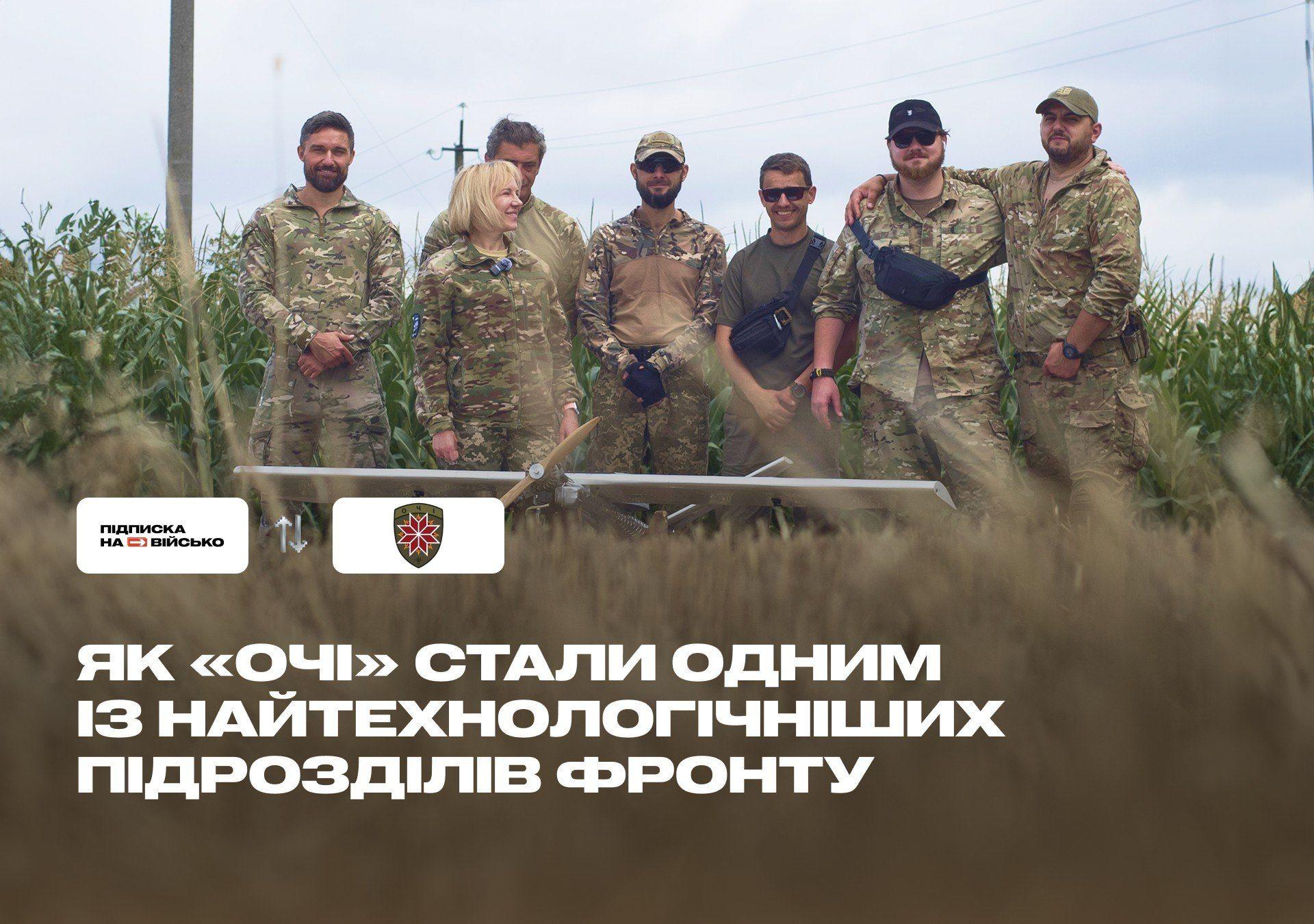
The Kursk direction remains one of the fronts where technology increasingly determines the outcome of battle.
This is where the 425th Separate Unmanned Systems Battalion “OCHI” is carrying out its missions. The unit grew out of the company of the same name, created in 2022. Its servicemen took part in the liberation of Kharkiv region, the defense of Vuhledar and Bakhmut, and in 2024 an independent battalion was formed on the basis of that company.
From Kharkiv region to the Kursk direction
Today, “OCHI” combines different areas of work with unmanned systems: short- and long-range reconnaissance, FPV drones, bombers, fiber-optic drones, reconnaissance aircraft, and ground robotic systems.
“We operate practically the entire arsenal of unmanned systems. We also have a company of ground robotic systems used for logistics and evacuation of the wounded,” says battalion servicewoman Maryna Holub.
One of the key advantages of the unit, she says, is its own information and communication system “OCHI,” which they began developing back in 2022.
“At that time, it had no analogues. Thanks to it, we were able to see what the enemy was trying to hide. Today, the system continues to evolve in response to new challenges of war,” the servicewoman says.
A war of engineers and technology
However, technological superiority requires constant investment.
According to Maryna Holub, modern warfare changes so quickly that units are forced to continuously improve equipment and search for new solutions.
“The enemy does not stand still. Just as we try to counter them, they are also looking for ways to counter us. That is why we are constantly working on technical equipment and improving the characteristics of the systems we use,” she explains.
Each company within the battalion has its own specialists who modify equipment, configure communication systems, write software, and improve unmanned complexes.
This requires regular supplies of materials and components that are not always covered by state support.
“These include various parts for communication systems, materials for 3D printers, and much more,” says Maryna Holub.
Where subscription funds go
That is why the battalion joined the “Subscribe to army” project, which allows citizens to set up recurring support for a specific unit.
According to the servicewoman, the special feature of the platform is that even small contributions become part of systematic support.
“The platform makes it possible to make your donation planned and regular. It is also important that even a small contribution becomes part of a bigger cause,” she notes.
The battalion emphasizes that high-tech warfare is expensive.
Recently, the unit launched a fundraiser for a reconnaissance aircraft capable of operating deep in enemy rear areas. The cost of such a project is measured not in hundreds of thousands, but in millions of hryvnias.
“For us, UAH 100,000 is not that significant an amount. For example, right now we are raising funds for a reconnaissance aircraft that will allow us to see deep into enemy rear areas. Its cost can reach ten million hryvnias,” says Maryna Holub.
At the same time, even such funds help cover urgent needs.
“With this money, we can purchase many materials to improve our systems and developments,” she adds.
Every hryvnia works at the front
For the military, support is important not only in material terms.
“We understand that it is not easy for people right now. But the enemy has not abandoned its intentions. Every hryvnia that comes to the battalion works toward destroying the enemy,” says Maryna Holub.
And to those who doubt whether UAH 50 can make any difference, the battalion has a simple answer:
“If everyone donates UAH 50 today, tomorrow we will destroy more invaders, expand our kill zone, and prevent the enemy from reaching our infantry. That is the real value of every donation — the lives of our people.”


